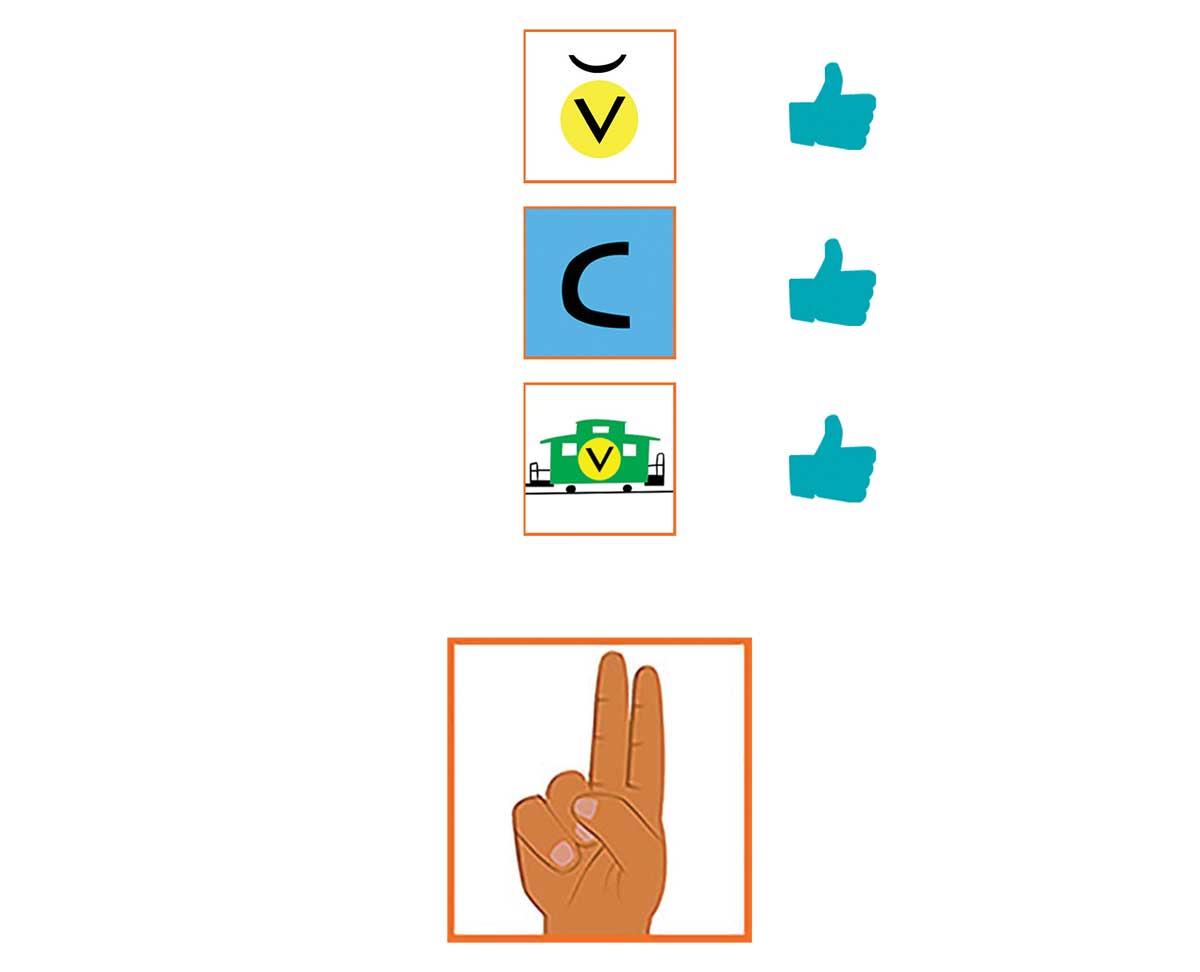

“Three Thumbs Up to Double” is used to help remind us when to use the Suffix Endings: Double function, which is where we double the last consonant of the base word before adding a vowel suffix.
When adding a vowel suffix, there are only two choices for the end of the base word: leave it or double it. To decide to double, ask these three questions and look for a thumbs up each time.
Does the base word have one vowel? If yes, that is the first thumbs up.
Does the base word end with one consonant? If yes, that is the second thumbs up.
Are we adding a vowel suffix? If yes, that is the third thumbs up.
If there are three thumbs up, double the last consonant before adding the vowel suffix.
If there are not three thumbs up, use the leave function and do not change the base word.

We primarily use “Three Thumbs Up to Double” with one-syllable words. It can also be used with multisyllable words, most often two-syllable words, when the last syllable of the base word is accented. This is less common because, in English, the first syllable is usually accented.
Using “Three Thumbs Up to Double” with multisyllable words can be tricky because it depends on how the word is spoken, not how it looks. Pronunciation can change based on region, speaker, or how the word is used. Some multisyllable words may even have more than one accented syllable, which adds to the challenge.
Whenever possible, listen carefully for the accented syllable. If it is hard to hear, ask your Instructor or look the word up. When in doubt, remember that most multisyllable base words are not accented on the last syllable, and Three Thumbs Up to Double is usually not used.
Examples of doubling in multisyllable words: admitting, regretted, transferrable.